The Three-Fund Portfolio: The Simplest Path to Financial Independence
Most investment portfolios are overcomplicated. Dozens of holdings, multiple fund families, overlapping strategies — and they still underperform the market after fees.
Photo by Markus Winkler on Unsplash
The three-fund portfolio is the antidote. Three funds. The entire global stock and bond market. Nearly zero ongoing effort. And decades of evidence showing it beats the vast majority of actively managed alternatives.
What the Three-Fund Portfolio Is
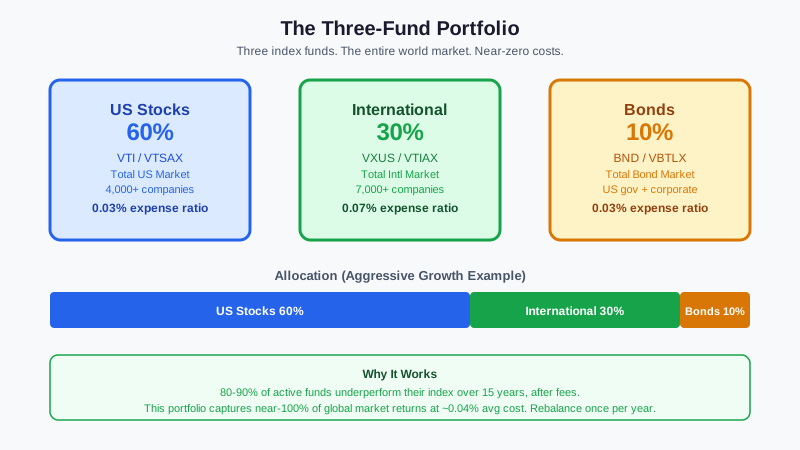
The three-fund portfolio consists of:
- Total US Stock Market — all publicly traded US companies
- Total International Stock Market — all publicly traded companies outside the US
- Total Bond Market — US government and corporate bonds
That's it. You own a slice of virtually every publicly traded company in the world, plus bonds for stability.
Why It Works
The math is brutal
About 80–90% of actively managed mutual funds underperform their benchmark index over a 15-year period, after accounting for fees. This isn't because fund managers are incompetent — markets are highly efficient, and fees are a guaranteed drag on returns.
The three-fund portfolio is almost pure market return, minus tiny fees. Vanguard's equivalent funds charge around 0.03–0.07% annually (that's $3–$7 per $10,000 invested). Compare that to an actively managed fund at 1%+ — a difference that compounds dramatically over decades.
Diversification is as complete as it gets
Owning thousands of companies across dozens of countries, you're not betting on any single company, sector, or country. If US tech stocks crash, emerging markets may hold steady. If bonds fall, stocks might rise. The correlation between these three asset classes means genuine risk reduction.
Behavioral advantage
Simple portfolios are easier to stick with. When markets drop, investors with complicated strategies often panic-sell or make wrong adjustments. Three funds means three things to check. That simplicity keeps you from tinkering in ways that hurt returns.
The Funds
At Vanguard
| Fund | Ticker (ETF) | Ticker (Mutual Fund) | Expense Ratio |
|---|---|---|---|
| Total US Stock Market | VTI | VTSAX | 0.03% |
| Total International Stock | VXUS | VTIAX | 0.07% |
| Total Bond Market | BND | VBTLX | 0.03% |
VTSAX is the most widely discussed three-fund option. It requires a $3,000 minimum for the mutual fund version; VTI (the ETF equivalent) can be bought for the price of one share and is functionally identical.
At Fidelity
| Fund | Ticker | Expense Ratio |
|---|---|---|
| Total Market Index | FSKAX | 0.015% |
| Total International Index | FTIHX | 0.06% |
| US Bond Index | FXNAX | 0.025% |
Fidelity's funds have no minimums and slightly lower expense ratios. If you're starting out or investing smaller amounts, Fidelity may be more accessible.
At Schwab
| Fund | Ticker | Expense Ratio |
|---|---|---|
| Total Stock Market Index | SWTSX | 0.03% |
| International Index | SWISX | 0.06% |
| US Aggregate Bond Index | SWAGX | 0.04% |
All three major brokerages offer equivalent funds. Pick the one where your accounts already are — the differences are negligible.
Want more investing guides? Get guides like this in your inbox — Frugal Rise delivers one free deep-dive every week.
Choosing Your Allocation
Stock/bond split
The key decision is how much to put in stocks versus bonds. Stocks have higher expected returns but more volatility. Bonds provide stability but lower returns.
Common approaches:
- Age in bonds: If you're 30, hold 30% bonds. Simple, gradually becomes more conservative over time.
- 110 minus age: More aggressive variant — if you're 30, hold 20% bonds
- Target date funds: Let the fund company manage allocation for you (they use a similar glide path)
Rough guidelines:
- 20s–30s with a long horizon: 90% stocks / 10% bonds is reasonable, some people go 100% stocks
- 40s–50s: 80% stocks / 20% bonds
- 60s+: 60% stocks / 40% bonds, shifting toward capital preservation
These aren't rules — they're starting points. Adjust based on your risk tolerance, other income (pension, Social Security), and how you'd actually behave in a 40% market crash.
US vs. international split
For the stock portion, a common split is 60–70% US / 30–40% international. US stocks have had better returns for the past 15 years, but international stocks have outperformed in other periods. Holding both captures global growth and reduces geographic concentration.
A simple approach: match the global market cap weight, which is currently about 60% US / 40% international.
Example Portfolios
Aggressive growth (early career)
| Fund | Allocation |
|---|---|
| VTI (Total US Stock) | 60% |
| VXUS (Total International) | 30% |
| BND (Total Bond) | 10% |
Balanced (mid-career)
| Fund | Allocation |
|---|---|
| VTI | 48% |
| VXUS | 24% |
| BND | 28% |
Conservative (near retirement)
| Fund | Allocation |
|---|---|
| VTI | 36% |
| VXUS | 18% |
| BND | 46% |
Tax Account Placement
Where you hold these funds matters:
Tax-advantaged accounts (401k, IRA, Roth IRA):
- Bonds: Interest is taxed as ordinary income, so hold bonds in tax-advantaged accounts where that tax is deferred or eliminated
- Total bond market fund goes here first
Taxable brokerage accounts:
- Stock index funds are tax-efficient (low turnover, mostly qualified dividends)
- International funds can provide foreign tax credit in taxable accounts (minor but real benefit)
If all your investing is in tax-advantaged accounts, placement doesn't matter — just hold all three.
Rebalancing
The portfolio drifts as markets move. If stocks have a great year, you might end up with 95% stocks when you wanted 80%.
Annual rebalancing is enough for most investors. Simply:
- Check your actual allocation once a year
- If any fund is more than 5% off target, adjust
- Sell the overweight fund and buy the underweight one
In tax-advantaged accounts, this is free and tax-neutral. In taxable accounts, selling creates a taxable event — so many investors rebalance by directing new contributions to the underweight fund rather than selling.
The One-Fund Version
If even three funds feels like too many decisions, target date retirement funds package the same concept into a single fund. Vanguard Target Retirement 2055 (VFFVX), for example, holds the same three fund types automatically and adjusts the allocation as you approach retirement.
The trade-off: slightly higher expense ratio (0.08% vs. the 0.03–0.07% of individual funds) and less control over your exact allocation. For most people, this trade-off is worth it.
Common Objections
"But what about sector funds, real estate, commodities?"
You already own real estate (through REITs in total market funds), commodities companies, and every sector. Adding sector funds introduces concentration and typically higher fees without improving expected returns.
"US stocks have beaten international for 15 years — why hold international?"
Past performance isn't predictive, and international stocks have had long periods of outperformance. In the 2000s, international stocks significantly outperformed US stocks. Diversification is insurance against not knowing which market will do better in the next decade.
"Shouldn't I be in bonds while inflation is high?"
Bond prices fall when rates rise, which was painful in 2022. But bonds are held for stability and income, not inflation protection. If inflation protection is your goal, I-bonds and TIPS are better tools (see our guide on I-bonds).
Getting Started
- Choose a brokerage: Vanguard, Fidelity, and Schwab are all excellent. Start where you have existing accounts.
- Open the right account type: Roth IRA first if eligible, then maxing 401k, then taxable brokerage.
- Pick your allocation: Use age-in-bonds as a starting point, adjust for your comfort with volatility.
- Automate contributions: Set up automatic monthly investments.
- Set a rebalancing reminder: One calendar event per year.
The three-fund portfolio doesn't have a higher complexity ceiling — this is the whole strategy. Your job after setting it up is mostly to not touch it.