Lazy Portfolio Strategies: Less Work, Better Results
The investing industry wants you to believe that successful investing requires constant attention, frequent trades, and expert guidance.
Photo by Markus Spiske on Unsplash
The data disagrees.
Lazy portfolios — typically 2 to 5 index funds held for decades — consistently beat the majority of actively managed funds, complex strategies, and most professional investors. They're called "lazy" because once you set them up, the right move is to do almost nothing.
What Makes a Portfolio "Lazy"
A lazy portfolio has three characteristics:
- Low cost — expense ratios under 0.1%
- Broad diversification — owns thousands of securities, not a handful
- Minimal maintenance — reviewed annually, not daily
Most use plain vanilla index funds from Vanguard, Fidelity, or Schwab. The goal is capturing market returns efficiently, not trying to beat the market.
Popular Lazy Portfolio Strategies
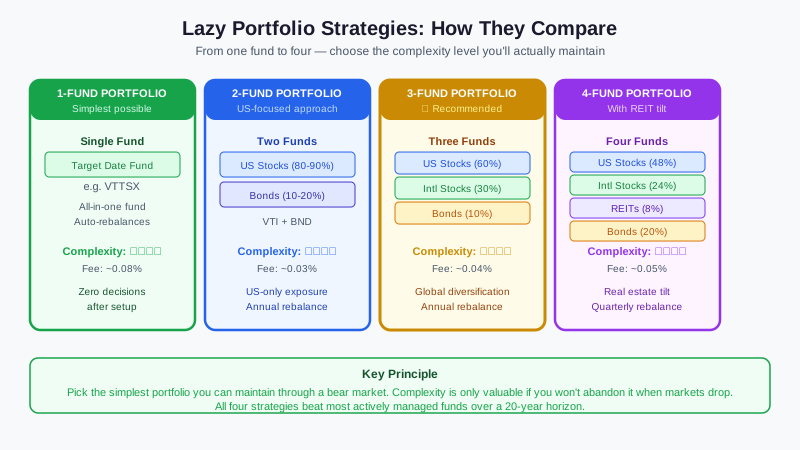
The One-Fund Portfolio
Fund: Target Date Retirement Fund (e.g., VTTSX for 2060 target) Expense ratio: ~0.08%
The ultimate in simplicity. A single fund holds the entire global stock and bond market and automatically shifts more conservative as the target date approaches.
Who it's for: Anyone who wants to set it and forget it completely, doesn't want to think about allocation, or is just starting out.
Trade-off: Slightly higher fees than building it yourself, and less control over your exact stock/bond split.
The Two-Fund Portfolio
Funds:
- Total US Stock Market (VTI / FSKAX) — 80–90%
- Total Bond Market (BND / FXNAX) — 10–20%
Two funds. The entire US stock market, plus bonds for ballast.
Who it's for: Investors comfortable with a US-only stock exposure who want simplicity over maximum diversification.
Trade-off: No international exposure. The US represents about 60% of global market cap — you're missing 40% of the world economy. This has hurt returns in periods of dollar weakness and will likely matter over multi-decade timeframes.
The Three-Fund Portfolio (The Standard)
Funds:
- Total US Stock Market (VTI / VTSAX) — ~60%
- Total International Stock (VXUS / VTIAX) — ~30%
- Total Bond Market (BND / VBTLX) — ~10%
The three-fund portfolio adds international stocks to the two-fund version, giving true global diversification. This is the most widely recommended lazy portfolio.
Common allocations by risk tolerance:
| Risk Level | US Stocks | International | Bonds |
|---|---|---|---|
| Aggressive | 60% | 30% | 10% |
| Balanced | 48% | 24% | 28% |
| Conservative | 36% | 18% | 46% |
Who it's for: Most investors who want comprehensive diversification with three straightforward decisions.
The Four-Fund Portfolio
Funds:
- Total US Stock Market — 50%
- Total International Stock — 20%
- REITs (Real Estate Investment Trusts) — 10%
- Total Bond Market — 20%
Adds a real estate tilt. REITs provide exposure to commercial real estate and historically have a low correlation with the broader stock market.
Note: Total stock market funds already include REITs proportional to their market cap. Adding a dedicated REIT fund overweights real estate. Whether this is a feature or a bug depends on your view.
Who it's for: Investors who believe real estate deserves more than its market weight, or who want direct exposure to the sector.
The Coffeehouse Portfolio (Seven Funds)
A classic lazy portfolio from author Bill Schultheis:
- US Large Cap Index: 10%
- US Large Cap Value Index: 10%
- US Small Cap Index: 10%
- US Small Cap Value Index: 10%
- International Index: 10%
- REITs: 10%
- Bond Index: 40%
This adds "factor tilts" — overweighting value stocks and small-cap stocks based on academic research showing these categories historically earn a premium.
Who it's for: Investors who want some exposure to value and small-cap factors while maintaining index-fund discipline.
Trade-off: Seven funds means more rebalancing work and more chances to tinker. Whether the factor tilts add returns after fees over the long run is debated.
Rick Ferri's Core Four
- Total US Stock Market: 48%
- Total International Stock: 24%
- REITs: 8%
- Total Bond Market: 20%
Minimal extra complexity over the three-fund portfolio, with a moderate real estate tilt.
How to Choose Your Lazy Portfolio
Ask yourself three questions:
1. How much complexity can you tolerate without tinkering? More funds = more decisions = more temptation to make changes. If you're a tinkerer, start simpler. You can always add complexity later. You can rarely remove it emotionally once you're in.
2. What's your time horizon? 20+ years out: lean heavily toward stocks. Within 5–10 years of retirement: start shifting toward bonds. Within 5 years of needing the money: be conservative.
3. What allocation will you hold during a 40% crash? In 2022, the stock market dropped 20% and bonds dropped 15% simultaneously. In 2020, stocks dropped 30% in three weeks. In 2008–09, stocks fell 50%. Could you hold your current allocation through any of these without selling? If not, add more bonds.
Want more investing guides? Get guides like this in your inbox — Frugal Rise delivers one free deep-dive every week.
Rebalancing Without Overthinking It
Even lazy portfolios drift and need occasional rebalancing.
The 5/25 rule: Rebalance when an asset class is more than 5 percentage points off target, or more than 25% of its target allocation (whichever is smaller). So if bonds are targeted at 20%, rebalance if they drop below 15% or rise above 25%.
In practice: Most lazy investors check once a year. If something is significantly off target, they redirect new contributions to the underweight fund before selling anything.
In taxable accounts: Rebalancing by selling creates a taxable event. When possible, rebalance using new contributions instead of selling overweight positions.
Tax Account Strategy
Put the funds in the right accounts to minimize taxes:
| Account Type | Best Funds |
|---|---|
| Roth IRA (tax-free growth) | Highest-growth assets — stock funds |
| Traditional IRA / 401k | Bond funds (interest taxed as ordinary income anyway) |
| Taxable brokerage | Stock index funds (low turnover, tax-efficient) |
If all your investments are in one type of account, don't stress about placement — just hold the portfolio.
Lazy Portfolio vs. Target Date Funds
A target date fund is a one-fund lazy portfolio. It's appropriate for most investors. The main reason to build a lazy portfolio yourself:
- Lower fees: DIY portfolios use 0.03–0.07% funds; target date funds charge 0.08–0.15%
- Control: You decide the exact allocation, not the fund company
- Separate accounts: Easier to hold specific funds in specific account types for tax optimization
For most people, especially early in their investing journey, a target date fund is the right choice. As your portfolio grows and the fee difference becomes meaningful ($1M × 0.07% = $700/year), building your own makes sense.
Common Mistakes
Adding complexity over time. You start with three funds, then add a dividend fund, a small-cap value fund, an emerging markets fund... suddenly you have twelve funds and can't remember your allocation. Resist. More funds is not better.
Checking daily. The portfolio is designed to be ignored. Looking at it during market downturns creates an opportunity to panic-sell at the worst moment.
Abandoning the strategy in a crash. The evidence strongly shows that investors who stay the course through crashes recover and outperform those who move to cash. The lazy portfolio only fails if you abandon it when it matters most.
Forgetting to rebalance. Annual check-in is the minimum maintenance. After a long bull market, you might be 10% over your stock target — that means more risk than you signed up for.
Getting Started in 30 Minutes
- Open a Roth IRA at Vanguard, Fidelity, or Schwab (if you're under the income limit)
- Contribute (2026 limit: $7,000 if under 50)
- Buy the three-fund portfolio (VTI + VXUS + BND in your target proportions)
- Set a calendar reminder for an annual rebalance review
- Automate monthly contributions so you never have to decide to invest
The entire strategy takes 30 minutes to set up and maybe 30 minutes per year to maintain. That's the point.