The Bogleheads Philosophy: How Most Investors Lose to the Market (And How to Beat Them)
In 1974, a mutual fund manager named John Bogle founded Vanguard on a radical idea: that investment companies should be owned by the investors whose money they manage, not by outside shareholders. He then launched the first index fund available to ordinary investors.
Photo by Morgan Housel on Unsplash
Wall Street thought he was crazy. His competitors called it "Bogle's Folly."
Fifty years later, index funds hold more assets than actively managed funds. The evidence is overwhelming. And the millions of investors who follow Bogle's principles — called Bogleheads — have quietly outperformed most professional investors.
Who Were the Bogleheads?
Bogle died in 2019, but his community lives on at bogleheads.org, one of the most data-driven personal finance forums on the internet. Unlike typical investment forums, there's minimal hype, no hot stock tips, and a strong aversion to complexity. The philosophy is grounded in academic research and long-term evidence.
The community was built around Bogle's core books: Common Sense on Mutual Funds and The Little Book of Common Sense Investing. The central thesis: stop trying to pick winners, own everything, and keep costs ruthlessly low.
The Core Principles
1. Invest early and often
Time in the market beats timing the market. A dollar invested at 25 is worth dramatically more than a dollar invested at 35, because of compounding. The Boglehead approach starts with automating contributions before lifestyle inflation can absorb the money.
2. Never bear too much or too little risk
Risk is a dial, not a switch. Too little risk (all bonds, all cash) means insufficient long-term returns. Too much risk (all stocks) means panic-selling in a crash, which locks in losses permanently.
The right risk level is one you can tolerate emotionally during a 40% market decline without selling. If you couldn't sleep in 2020 when the market dropped 30% in three weeks, you had too much risk. If you didn't notice, you may be able to take on more.
3. Diversify broadly
Own everything, not a concentrated bet. US stocks, international stocks, bonds. No sector concentration, no country concentration, no single-company risk. Broad diversification is the closest thing to a free lunch in investing — it reduces risk without reducing expected returns.
4. Never try to time the market
There is no reliable method for predicting market tops and bottoms. Investors who move to cash "until things settle down" typically miss the recovery, which often happens in a few violent up-days that are impossible to predict.
The data is damning: studies of investors in actively managed funds consistently show they underperform the funds themselves, because they buy high and sell low emotionally.
5. Use index funds
Index funds buy everything in an index (like the S&P 500 or Total Stock Market) proportional to market cap. They don't try to pick winners. As a result:
- They have very low turnover (few taxable events)
- They have minimal management fees (no analysts to pay)
- They capture the full market return
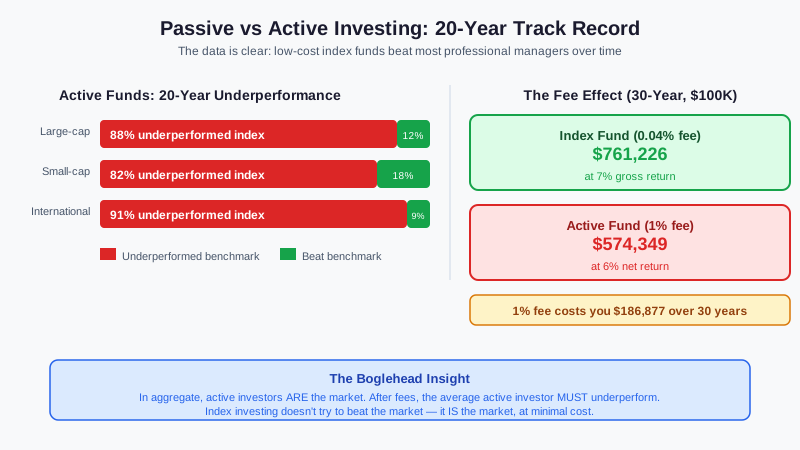
Most actively managed funds underperform their index benchmark over the long run. The ones that outperform one decade rarely continue outperforming the next.
6. Keep costs low
This is the Bogleheads' most emphatic principle. Every dollar paid in fees is a dollar that doesn't compound over the next 30 years.
The impact of 1% annual fees:
- $100,000 invested for 30 years at 7% return: $761,226
- Same investment with 1% fee (net 6%): $574,349
That 1% fee costs you $186,877 on a $100,000 starting investment. Over a career of contributions, the difference is often hundreds of thousands of dollars.
Index funds from Vanguard, Fidelity, and Schwab charge 0.015% to 0.07%. Most actively managed funds charge 0.5% to 1.5%. The difference sounds small. It isn't.
7. Minimize taxes
Tax drag is like a fee you pay to the government instead of a fund company — equally damaging to long-term wealth.
Boglehead tax strategies:
- Maximize tax-advantaged space first (401k, Roth IRA, HSA)
- Asset location: put bonds in tax-advantaged accounts, stocks in taxable accounts
- Never sell to rebalance in taxable accounts if you can avoid it (use new contributions)
- Hold index funds in taxable accounts (low turnover = fewer taxable events)
8. Stay the course
The hardest part of the Boglehead philosophy isn't intellectual — it's behavioral. Markets crash. Headlines are terrifying. Friends talk about hot stocks. Everyone seems to be making money in things you're not in.
The evidence is clear: investors who make changes based on fear or excitement tend to sell low and buy high, destroying the gains that staying put would have produced. Do nothing is often the right answer.
What the Bogleheads Don't Do
They don't pick stocks. Individual companies go bankrupt, get disrupted, and have accounting scandals. Owning 3,000 companies means any one failure is trivial.
They don't time the market. If the market is "overvalued," so what? Nobody reliably knows when it will correct or by how much.
They don't chase recent performance. Last year's winners are not reliably next year's winners.
They don't pay financial advisors who charge 1% AUM. If you need help, fee-only advisors who charge by the hour are far cheaper.
They don't hold complicated products. Annuities with surrender charges, leveraged ETFs, sector funds, hedge fund replication — all unnecessary.
Want more investing guides? Get guides like this in your inbox — Frugal Rise delivers one free deep-dive every week.
The Boglehead Portfolio
Most Bogleheads invest in the three-fund portfolio:
- Total US Stock Market (VTSAX or VTI)
- Total International Stock Market (VTIAX or VXUS)
- Total Bond Market (VBTLX or BND)
Some keep it even simpler with a single target-date retirement fund. Others hold only two funds (total world stock + bonds). The common thread: broad, low-cost, and set-it-and-forget-it.
Common Arguments Against (And Why They're Wrong)
"Index funds are socialist — they own everything including bad companies."
Every dollar in an actively managed fund also indirectly owns the market, because active funds collectively are the market. When active managers buy a "good" company and sell a "bad" one, someone else is doing the opposite. Index investors own the good and bad — but so does everyone else, on average.
"Markets are volatile — you'll lose everything."
The US total stock market index has never gone to zero. It has declined 50%+ twice in the past 25 years — and both times fully recovered within a few years. Someone who invested $10,000 in 2000 (the worst timing possible, right before the dot-com crash) had roughly $75,000 in 2025, purely from sitting still.
"I can pick a better actively managed fund."
You can't reliably identify which fund will outperform over the next 20 years. Neither can the experts. Survivorship bias makes past winners look more predictable than they are — the funds that closed or merged don't appear in the historical rankings.
How to Start
- Read the basics: The Little Book of Common Sense Investing by Jack Bogle. It's short, clear, and foundational.
- Open accounts at Vanguard, Fidelity, or Schwab
- Invest in the three-fund portfolio (or a target-date fund)
- Automate contributions — set it and forget it
- Visit the bogleheads.org forum when you're tempted to deviate from the plan
The Boglehead path is boring. It should be boring. Your investment strategy should not be exciting — the goal is wealth, not entertainment.